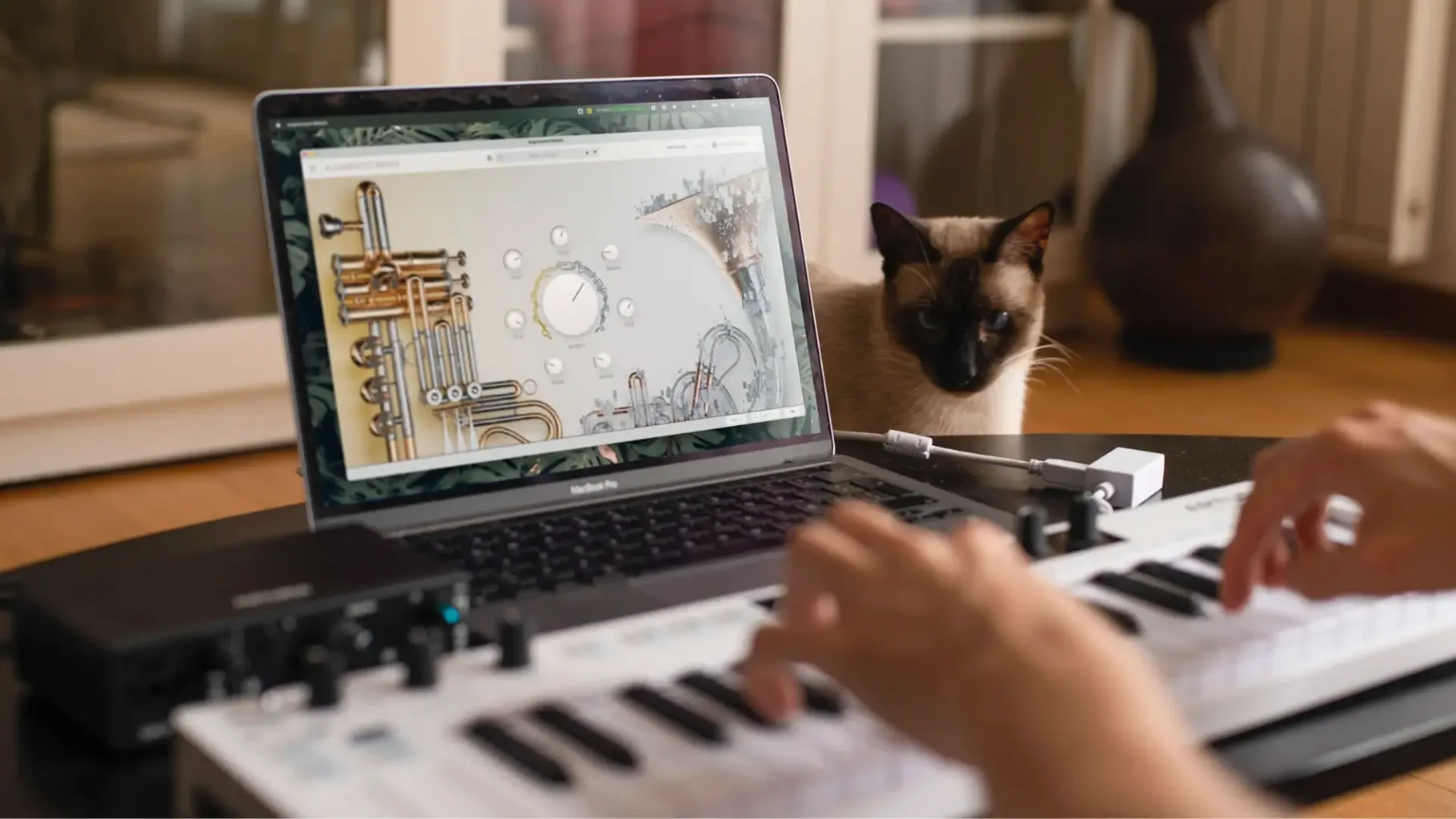
Augmented BRASS is a plugin and standalone instrument that puts a morphing brass-synth hybrid right where your MIDI controller needs it. It lives on instrument tracks, but the way it blends two layers per preset makes it just as useful for doubling a bass line or tucking a tense, airy pad behind a chorus.
Each layer packs two sound sources you can set independently—say, a close-mic’d flugelhorn sample on one side and a wavetable engine on the other. The fader between them isn’t a simple crossfade; it re-synthesizes the timbre in real time, so you get everything from a breathy, almost acoustic swell to a snarling synthetic stab without touching another plugin.
Where it fits in a session depends on the job. For a cue with a tight deadline, I’ll pull up a muted trumpet patch, dial the morph toward the sample side for attack, and print it to an audio track before I’d ever stack three processing chains. On a bus, sending a few stems through the same reverb as the rest of the brass section glues it into a mix faster than any EQ trick.
The sample library comes from a specialist studio in Europe, and the raw material is clean enough that you’re not fighting room tone when you push the synth layer forward. It’s a specific tool for a specific moment—when a pure orchestral library feels too polite and a straight-up synth patch sounds too cold.
Remap the Mod Wheel to Drive the Morph Fader
The mod wheel assignment isn't always set how I want it, so that's the first thing I dig into. Open the modulation panel and check whether the wheel controls the morph fader or a filter cutoff—whichever feels more musical for the session. I'll usually map it to the layer blend and leave aftertouch on vibrato depth.
Next, kill the onboard reverb if you're mixing into a template that already has a dedicated room bus. The built-in space sounds decent on its own, but double-wetting a brass part is the fastest way to make it sit behind the mix instead of in it. The same goes for the delay: disable it unless the part specifically needs a ping-pong throw. You can always add it back once the levels are roughed in.
Why That First Chord Sounds Like Angry Wasps
The biggest one I see: someone loads a preset, hits a chord, and wonders why it sounds like a swarm of angry wasps. Check the voice count. Some patches default to high unison settings that eat CPU for breakfast on complex voicings. Drop it to two or three voices per layer and you'll usually keep the thickness without the crackling.
Another head-scratcher is MIDI mapping. If your controller's knobs suddenly stop responding, the plugin probably grabbed a different MIDI channel than your keyboard is sending on. Standalone mode is pickier about this than the DAW version. Switch it to Omni mode or hard-set the channel to match your controller. Also, if notes hang after stopping playback, that's not a bug—it's the release sample triggering. Shorten the amp envelope release slightly on the offending layer and it'll clean up.
Synthesis-Shaping vs. Session Horns Pro’s Sectional Realism
Against Native Instruments Session Horns Pro, Augmented BRASS leans harder into synthesis. Session Horns Pro gives you sectional realism with smart voice splitting and articulations, which is great for big band mockups, but it won't turn a trumpet into a glassy pad. Augmented BRASS covers that hybrid territory that a pure sample library can't touch.
Compared to Spitfire Audio's Symphonic Brass, the difference comes down to intention. Spitfire captures a room and a performance—you're getting the sound of players in AIR Studios. Augmented BRASS doesn't compete there; it's for moments when you need a brass-like texture that morphs into something synthetic. A composer scoring a thriller might reach for both in the same cue.
u-he's Zebra can approximate some of the same hybrid brass territory with its comb filters and wavetable oscillators, but you'll spend twenty minutes dialing it in. Augmented BRASS gives you 300 presets with the morph engine already mapped and the sample layer sitting underneath. If patch design isn't the goal, that head start matters.
Version 2.0.2.6369 lands with clear macOS 11.0+ support, keeping the instrument stable on newer Apple Silicon and Intel machines. Also fixed: under-the-hood performance improvements that keep those dual-layer morphing patches from choking during a dense session.
- macOS 11 or later
- Apple Silicon (M1 or better) or Intel with a 4‑core CPU at 3.4 GHz
- 4 GB RAM
- 6 GB free disk space
Notes from the edit bay · 0
Sign in or get an edit-bay pass to leave a note.
No notes from the edit bay yet. They go up after I read them.