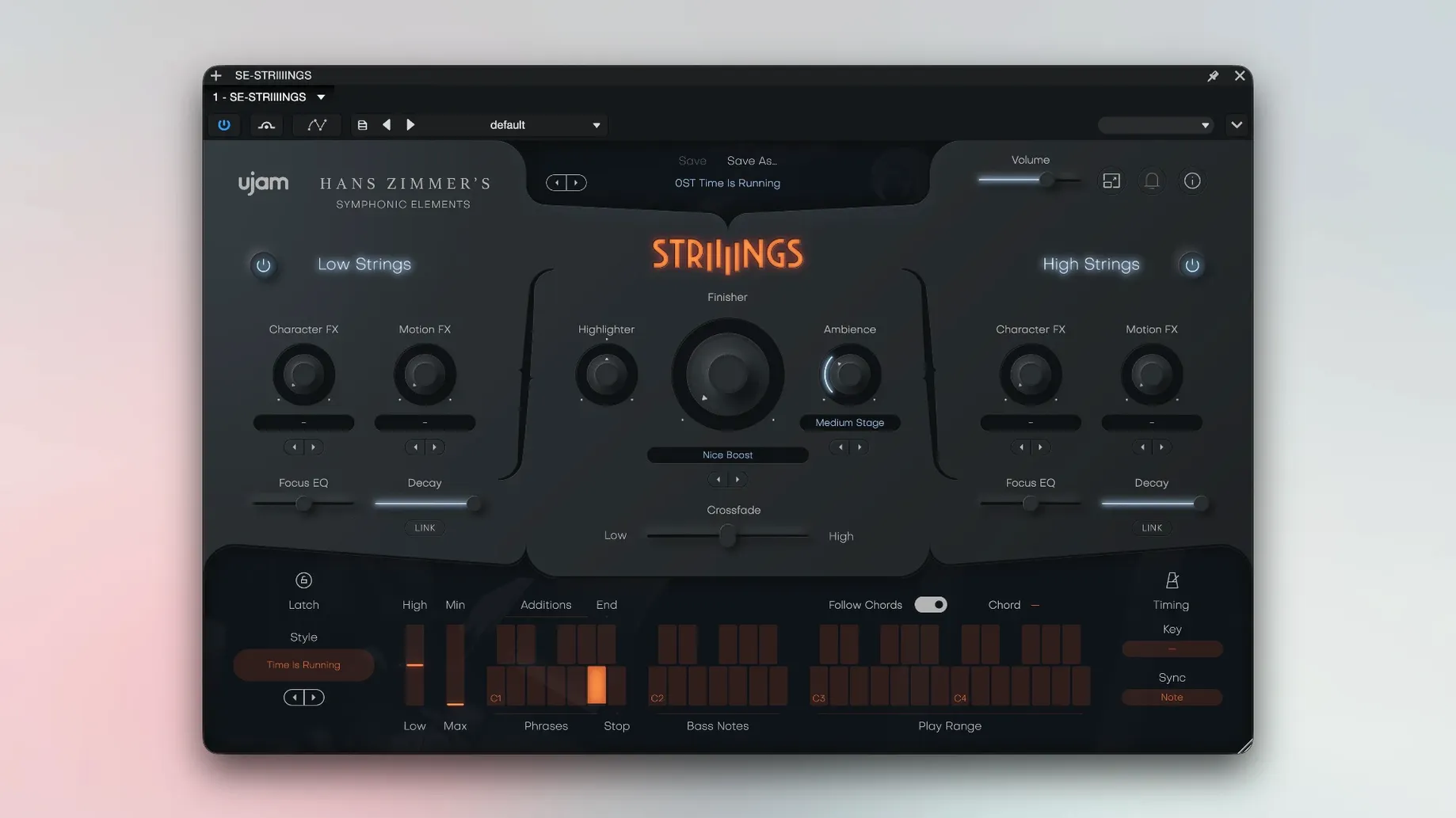
Composers chasing deadline-day tension cues and editors dropping temp music before a lock—this one’s aimed squarely at you. STRIIIINGS isn’t a traditional orchestral library where you build a section note by note. It’s a texture machine, and the first entry in uJAM’s Symphonic Elements series, built from recordings of Hans Zimmer’s own string library.
Compatibility and Hosts
Formats and host support are the first thing I check, so here’s the rundown:
- Runs on macOS 10.14 and later, native on both Apple Silicon and Intel Macs.
- 64-bit plug-in only—AU, VST, and AAX formats are in play, covering Logic Pro, Ableton Live, Pro Tools, and most other DAWs.
- 4 GB of RAM minimum; the library streams, so an SSD helps but isn’t mandatory.
- Windows support is there too, same formats.
In practice, I’ve dropped it into Logic on an M1 Max machine and it loads without a Rosetta hiccup. The plug-in does ask you to open it twice on first launch—just quit and reload the DAW, then it settles in.
Where the Sound Lives
The interface splits into two independent sections: High Strings (violins and violas) and Low Strings (basses and celli). A Crossfade control sits between them, letting you blend from airy, tense sustains down to growling low-end beds in a single move. There are 60 styles onboard, each one more of a performance snapshot than a static sample map. On top of that, over 200 sound designer presets twist those recordings into pulses, risers, and degraded pads that sit under dialogue without clutter. It’s not a phrase library—you play the parts and the engine handles the ensemble behavior behind the scenes.
Will an Extra Kontakt Install Slow Me Down?
Is this a Kontakt library? No—it runs in its own plug-in, no sampler host required. The download lands as a standard installer package, and activation details are included inside it. People often ask whether Symphonic Elements STRIIIINGS duplicates what they already own if they have a full string library. It doesn't. This one trades articulation switching and section seating for immediate, mix-ready texture. You won't program a convincing classical quartet, but you will sketch a dark, pulsing bed in under a minute.
Another frequent question: can it do soft and delicate, or is it all epic? The High Strings layer handles fragile sustains beautifully when you pull the dynamics back. Pair it with the onboard reverb and you can steer well clear of bombast. Ram requirements aren't punishing either—4 GB is the minimum, but a larger session with multiple instances will appreciate 16 GB or more. On Apple Silicon, the plug-in runs natively and didn't spike CPU beyond what I'd expect from a single virtual instrument track.
Can I Audition Patches Without Stopping Playback?
Loading a patch takes roughly two seconds from an SSD—fast enough that flipping through styles while the transport runs doesn't choke playback. The engine streams from disk, so first note latency stays low even with the larger ensemble styles. I've been running it inside Logic 10.8 on an M2 Pro Mac mini under Ventura, and it hasn't caused a single crash or hung note across a dozen sessions. Memory use sits around 600 MB per instance with the default preset, climbing a little when you stack both High and Low layers with heavy effects.
Real-time performance is solid. Playing chords with both sections active and the crossfader mid-travel keeps CPU draw under a single core's worth on Apple Silicon. On older Intel machines, the same patch pushes a little harder—expect an i7 from 2018 to handle maybe four or five instances before buffer adjustments become necessary. Bouncing in place solves that quickly when you're deep into a project.
Why Does It Demand a DAW Restart on First Launch?
The first-launch double-open requirement trips people up every time. After installing, load the plug-in, close your DAW, then reload it. The second launch authenticates properly and you won't see the prompt again. If you skip this step, the plug-in stays in demo mode and mutes periodically—just quit and relaunch the host to clear it.
Another hiccup: the crossfader sometimes sounds uneven if both sections are playing large chords at equal volume. The fix is simple—back off the High Strings level slightly before blending, because the violins cut through more aggressively than the celli and basses at the same fader position. A few users also note that the plug-in GUI scales blurry on high-DPI displays. It's not retina-optimized yet, though everything stays legible and functional.
If you're hunting down a torrent for ujam symphonic elements striiiings or the full ujam symphonic elements chooir v1. u2b mac [moria] package, make sure the installer matches your architecture. The native ARM build is a separate component from the Intel binary in most distributions, and dropping the wrong one into your Components folder gives you a validation failure in Logic. Check the readme inside the download—it usually spells out which files go where.
- macOS 10.14 or later
- Apple Silicon or Intel processor
- 64-bit host (AU, VST, AAX)
- 4 GB RAM
Questions I actually get
How do the two string sections work?
High Strings covers violins and violas, Low Strings handles basses and celli, and a Crossfade control lets you blend them in real time for shifting textures.
Notes from the edit bay · 0
Sign in or get an edit-bay pass to leave a note.
No notes from the edit bay yet. They go up after I read them.