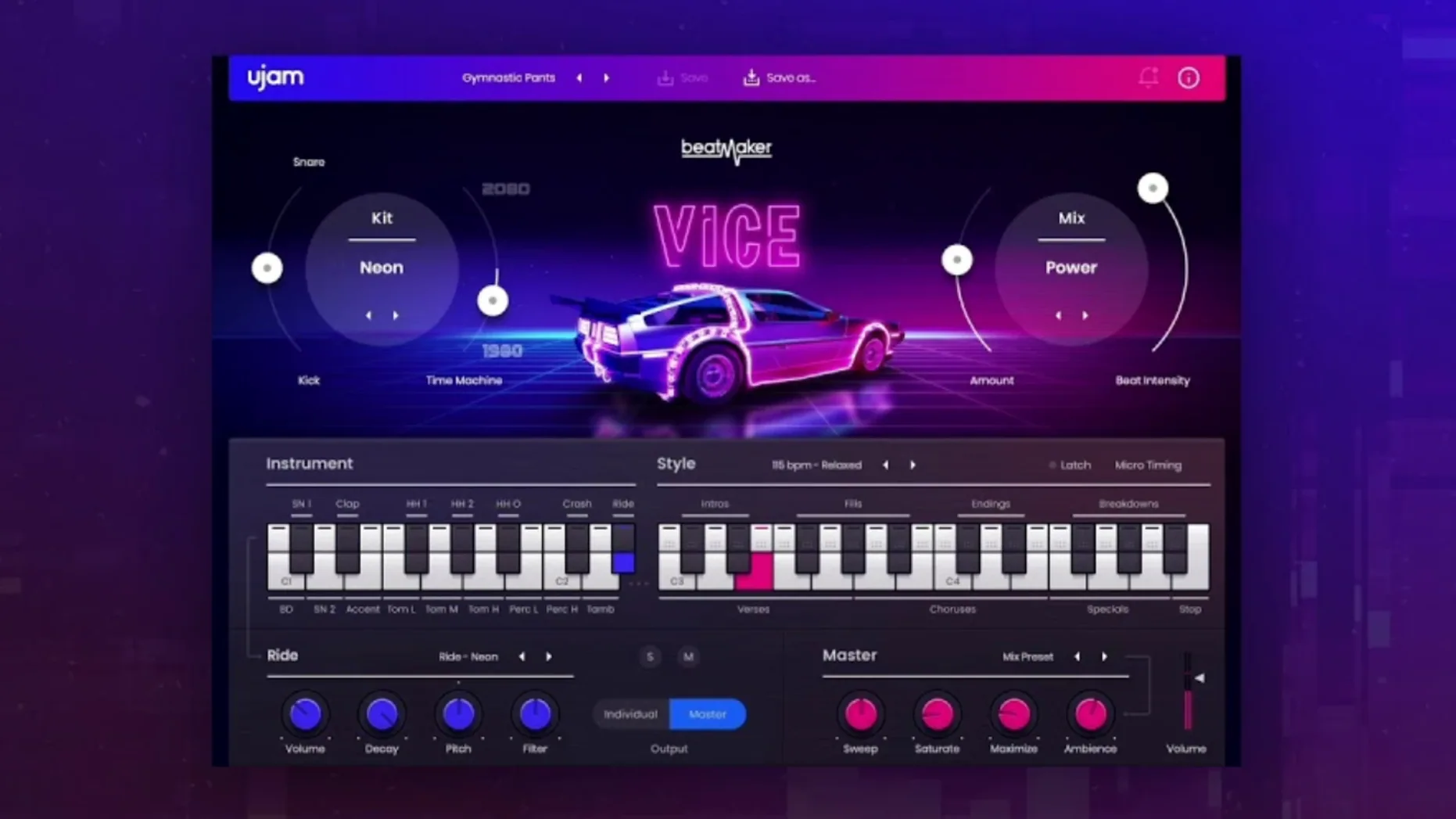
Beatmaker VICE runs on Intel and Apple Silicon Macs under macOS 10.15 or later. It shows up as VST 2, VST 3, AAX, or AU 2 in Ableton Live, Logic Pro, Cubase, and other major DAWs.
Think of building a kit as a short workflow:
- Pick a core sound. Ten kits span the gated snares of a Linn, the hollow thump of a Simmons tom, and the zing of a Roland hi-hat. Each hit is a processed version of an 80s machine, already sitting in a mix-ready space.
- Shape the character. The front panel gives you fast access to sample start, tuning, and decay per sound. A small nudge on the snare tuning can shift a pattern from pop sheen to a darker post-punk pocket.
- Feed the mixer. UJAM’s channel strip handles the heavy lifting. A single compressor knob glues the kick and snare together, while the reverb send drenches a clap in the kind of wide, nonlinear wash that defined early drum machines. The filter sweep adds instant movement without touching an EQ in your DAW.
- Guide the performance. Twenty styles and 460 patterns act like a session drummer who only speaks drum-machine. A "Heavy" style pushes a punchy, straight-ahead backbeat; a "Synthpop" setting introduces open hi-hat barks and tighter ghost notes. Drag a MIDI pattern into your session and tweak from there.
Where this fits: VICE isn’t a sample library you browse passively. The resizable interface puts tuning, decay, and mix tools on the surface so each pattern can be warped from a clean Linn emulation into a crushed, aggressive synthwave backbone without leaving the plug-in window.
Where VICE Sits in a Mac Workflow
VICE lives in the slot where you’d normally stack three or four plug-ins just to get a drum machine to sit right. On a typical Logic Pro project, I’ll drop it onto a software instrument track and feed the stereo output straight into the mix bus. No extra channel strip for gated reverb, no parallel bus for the snare — the internal mixer covers that ground before a single cycle hits the DAW.
It plays nicely with Apple’s Audio Unit ecosystem. On an Apple Silicon Mac, the AU 2 version loads inside Logic without Rosetta overhead, and the resizable UI scales cleanly on a Retina display. If you’re working in Ableton Live, the VST 3 build exposes MIDI drag-and-drop directly into a clip slot — grab a pattern, drop it, and Live treats it like any other MIDI clip. That matters when you’re layering VICE’s Simmons toms underneath a ujam mac torrent bassline from another UJAM instrument; the two plug-ins share a common MIDI resolution and lock in without nudging.
With other UJAM Beatmaker titles, the integration goes deeper. The hosting plug-in that installs alongside VICE means you can swap between VICE, EDEN, or DOPE inside one instance. Handy when a track starts as a synthwave sketch and morphs into something darker — drop in a different Beatmaker, keep the same MIDI pattern, and the groove translates without reprogramming.
Resizable Interface Now Remembers Your Window Size
Version 2.4.0 tidied up the most common friction points. The resizable interface now remembers its last state per session, so a project saved with the window at 125% reopens exactly there. Before that, you’d resize every time you opened the plug-in — a small thing, but one that ate thirty seconds per recall.
The MIDI drag-and-drop behaviour got more predictable. Earlier builds sometimes dropped a pattern a half-beat early if the DAW transport was running; 2.4.0 snaps to the bar regardless. The installer also streamlined the first-run experience. Instead of juggling a separate UJAM App download and the plug-in, the current package handles both in one pass. After authorisation, the app stays quiet in the background, updating the content library only when you prompt it.
Under the hood, the Apple Silicon native path is fully baked. No bridging, no AUHostingCompatibilityService popping up in Activity Monitor. That translates to lower CPU at low buffer sizes, which keeps the roundtrip tight when you’re finger-drumming patterns from a MIDI controller.
What to Know Before Installing VICE
VICE Needs a DAW or Host to Run
No. VICE is a plug-in only — it needs a DAW or a host like Blue Cat’s PatchWork. The upside: all pattern data and kit settings save inside the project file, so archival is simple.
Can I load my own samples?
The sound engine is closed. You’re shaping the ten supplied kits — tuning, decay, sample start, and the Time Machine knob that pushes sounds through a bit-reduction and clock-jitter engine. It’s a limitation that works in its favour when you need a cohesive palette quickly. For custom one-shots, I’d reach for a different tool, but VICE’s processed 80s sources rarely leave me wanting outside material.
Installer Asks for 0.96 GB, No Hidden Caches
The installer asks for 0.96 GB. The content — kits, patterns, and the shared Beatmaker framework — lands right around that mark. No hidden sample caches elsewhere.
Runs Fine on a 2015 MacBook Pro at 12–15% CPU
macOS 10.15 Catalina is the floor, and any Intel machine that runs it handles VICE. On a 2015 MacBook Pro, a four-bar loop with three kit pieces sits around 12–15% CPU in Logic, which leaves headroom for synths and effects.
Time Machine Knob Does More Than Lo-Fi
The Time Machine knob isn’t just a lo-fi effect. Dial it left, and it introduces clock instability that mimics a drifting VCO on an old drum machine; hard right, and sample-rate reduction folds the hi-hats into a crunchy wash. A sweet spot around 10 o’clock adds enough jitter to make a straight 16th-note hi-hat pattern feel like it’s being played off a cassette.
Right-click any pattern slot to export MIDI without dragging to the DAW timeline — it copies to the clipboard. Paste into a text editor if you want to archive a groove outside a session.
The mixer’s reverb send has a pre-delay baked into the algorithm that’s timed to 120 bpm. At faster tempos, it naturally tightens up; slow a track to 70 bpm, and the tail opens without cluttering the downbeat. UJAM never spells this out in the manual, but it’s consistent across every kit.
Finally, the ujam kaya torrent crowd often asks whether VICE’s patterns work across the Beatmaker family. They do. A pattern saved from VICE drops into EDEN or DOPE and triggers the equivalent kit pieces, which means a single groove library can drive three different sonic signatures without reauthoring. If you’ve grabbed a ujam torrent bundle, that cross-compatibility doubles the value of the preset collection you’re already scrolling through.
- macOS 10.15 or later
- Intel or Apple Silicon Mac
- VST 2, VST 3, AAX, or AU 2 host
Notes from the edit bay · 0
Sign in or get an edit-bay pass to leave a note.
No notes from the edit bay yet. They go up after I read them.