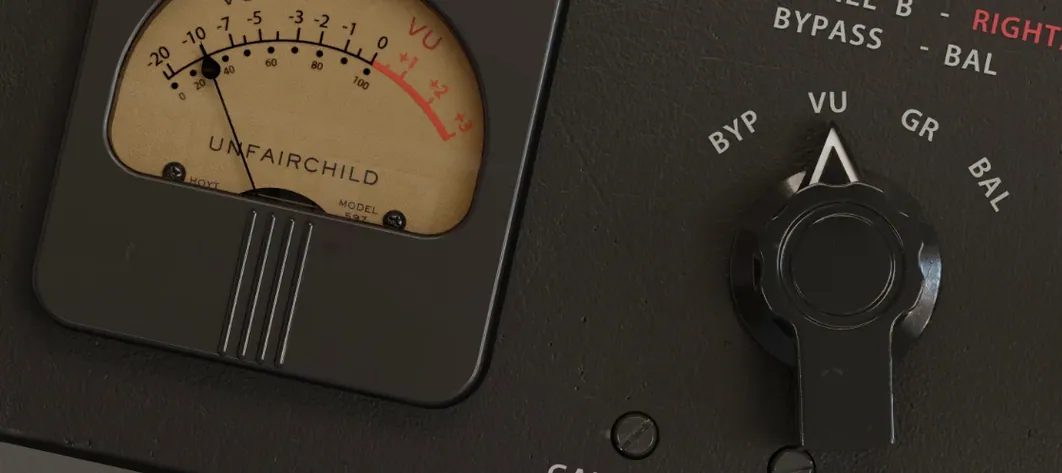
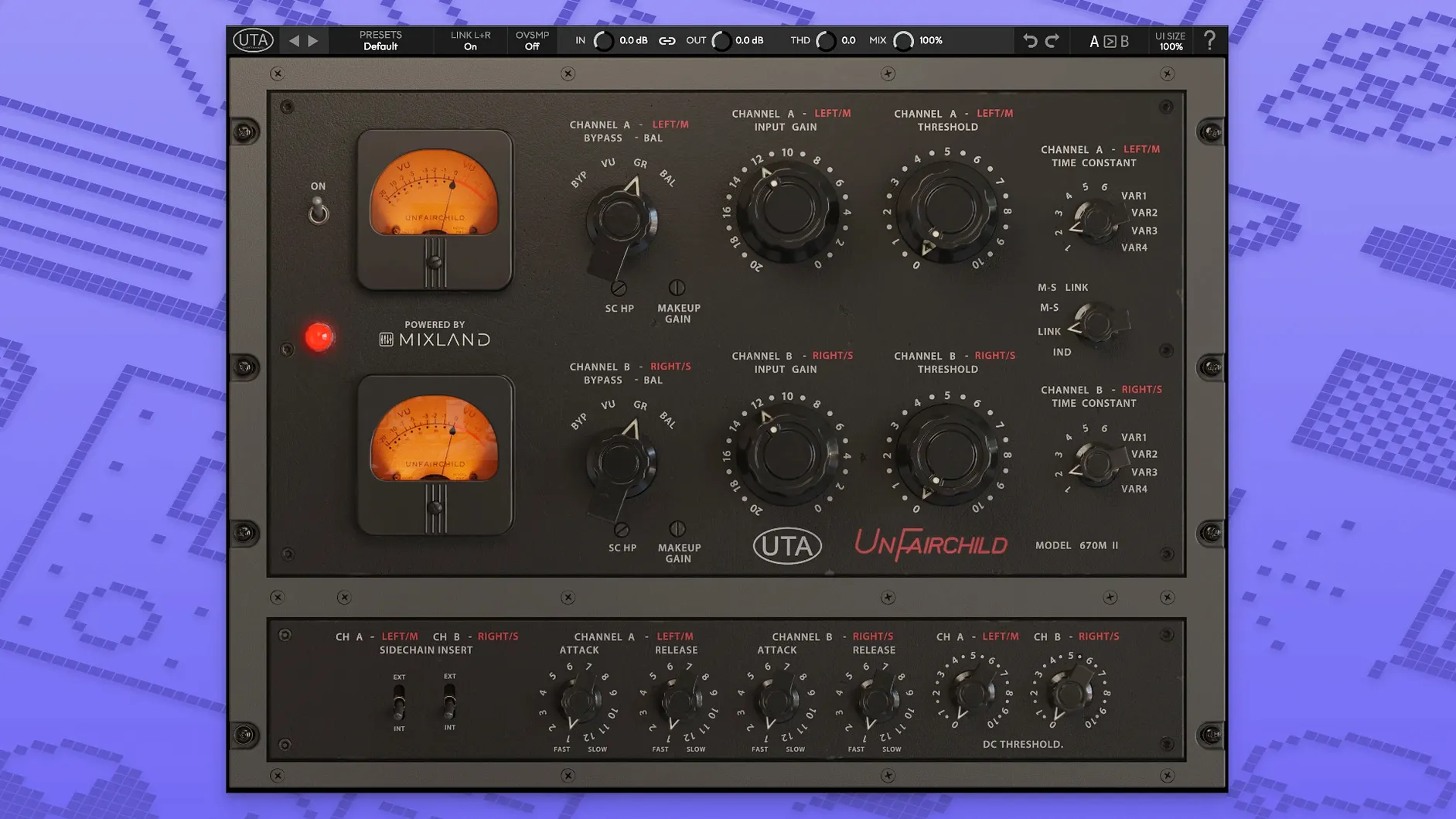
If you've ever patched a hardware vari-mu across a vocal and watched the meters breathe, you know the feeling. The UnderTone Audio UnFairchild aims for that same response without the rack space. It's a software version of the UnFairchild 670M mkII, built with MIXLAND and Eric Valentine, and it brings the hardware's behavior to a plugin you can drop on a track and forget is there.
Wet/Dry Parallel Compression That Preserves Transients
The wet/dry control is the first thing I reach for. Parallel compression on a drum bus keeps the transients intact while the vari-mu character fills in behind them. Six original preset time constants and four variable ones give you real flexibility — fast enough to grab a snare, slow enough to let a vocal phrase settle. Fine left/right balance adjustment matters when you're compressing a stereo bus and one side is working harder. The output level control keeps gain staging honest, and true bypass means you can A/B without second-guessing the plugin.
Vocal Weight and Drum Glue Without Pinning the Performance
Vocals and drum bus processing are the obvious homes. On a lead vocal, it adds weight without making the performance feel pinned down. On drums, a touch of parallel compression brings the room up and glues the kit together. It runs on Apple Silicon and 64-bit Intel Macs, so it slots into a modern setup without friction.
CPU Hunger of a Detail-Rich Vari-Mu Model
Most engineers download the UnFairchild plugin with a specific job in mind, but a couple of questions usually surface before the first insert. One is about CPU hunger. A vari-mu model with this much harmonic detail isn't a lightweight utility plugin, but it won't bring a modern Mac to its knees either. Expect it to sit comfortably on a handful of buses in a mix session — not the kind of plugin you throw on every channel, but perfectly manageable where it counts. If you're running an older Intel machine, just keep an eye on the session buffer when stacking instances.
Another common question: does it actually replace the hardware on a mix bus? The answer depends on what you're chasing. The plugin nails the compression curve and the way the sidechain reacts to program material, especially when you switch between Feed-Back and Feed-Forward modes. The hardware unit brings physical transformers into the path, and while the THD control gets you into that territory, the software version makes its strongest case on individual sources and subgroups where recall matters more than the last half-percent of analog saturation. For a mastering chain, I'd trust it. For a drum bus, I'd pick it over patching cables any day.
670 Voicing Versus a Softer, Rounder Vintage Take
If you've already grabbed an undertone download torrent or two, you probably have other vari-mu plugins in the folder. The obvious comparison is the UAD Fairchild collection. That one leans into the vintage 670 voicing with a slightly softer, rounder top end and a fixed personality that feels like a record from 1968. The UnFairchild plugin is sharper in the transient response — more modern, more adjustable, and the DC Threshold and THD controls give you a wider palette before you reach for a second plugin. If UAD's version is the sound of classic tracking, this one is the sound of a mix engineer who wants to dial in the exact amount of push.
Against something like Pulsar Audio's Mu, the differences get tighter. Mu does the smooth, transparent glue thing beautifully. The UnFairchild brings more harmonic excitement to the table, especially when you dig into the sidechain and play with the variable time constants. Mu disappears into a mix bus; the UnFairchild stamps a bit more character on the material. For post-production work, the MS function here is underrated — being able to compress the center channel independently while leaving the sides breathing is a trick you don't get in every vari-mu plugin.
Late-Night Rock Mix: Pulling Room Mics Up at 40% Wet
Picture a late-night mix on a rock track. The drum bus is hitting hard but feeling disconnected — transients poking out, room mics buried. I insert the UnFairchild on the drum bus and start with the wet/dry around 40%. Immediately, the parallel compression pulls the room into the foreground without softening the kick attack. I switch to a variable time constant, set it medium-slow, and watch the gain reduction needle move with the groove. The DC Threshold gets nudged up so the compressor ignores low-level cymbal wash and only grabs when the kick and snare hit. The kit tightens by a few decibels of gain reduction, and I bump the output level to match. No additional EQ needed.
Next, a vocal track that's been fighting the guitars. I set the sidechain to react only to the low-mid buildup, using the MS function to keep the sides transparent while the center gets squeezed gently. Feed-Forward mode changes the attack character — more assertive, less pillowy. I dial the THD control to about 25% and the vocal gains a subtle edge that sits it forward in the mix without turning up the fader. By the time I bypass the plugin, the vocal sounds two-dimensional by comparison. That's the test that matters.
Four or Five Instances on Apple Silicon Without a Flinch
On an Apple Silicon machine, the plugin loads instantly and recalls settings without hesitation. I've had it running on a busy mix session with four or five instances across buses and vocal chains, and the system didn't flinch. No GUI lag, no clicks during bypass, no parameter jumps when reopening a project. The interface is straightforward enough that you won't waste time hunting for controls, and the true bypass implementation is clean — toggle it fast in a blind A/B and the difference is immediate, not jarring.
Memory usage is modest; it's not a sample-based instrument, so it won't compete with your drum libraries for RAM. The rendering behavior is predictable too — offline bounces match real-time playback, which isn't always a given with analog-modeled dynamics. If you're downloading a torrent undertone package and wondering whether it'll hold up in a deadline situation, the answer is yes. The plugin feels finished, not like a public beta, and it stays out of the way until you need it to make a statement.
- macOS 10.13 or later
- Apple Silicon or 64-bit Intel Mac
- English interface
Questions I actually get
Is the UnFairchild plugin suitable for drum bus processing?
Yes, the official product page lists drum bus processing as a suitable use, and the wet/dry control makes parallel compression easy to set up.
Does the plugin run on Apple Silicon Macs?
Yes, it supports ARM and 64-bit x86 architectures, so it works on both Apple Silicon and Intel Macs.
Notes from the edit bay · 0
Sign in or get an edit-bay pass to leave a note.
No notes from the edit bay yet. They go up after I read them.