Murda Melodies runs on any Mac with Apple Silicon and macOS 11 or later. It loads as an AU, VST, VST3, or AAX inside Logic Pro, Ableton Live, FL Studio, Pro Tools, and practically any DAW that calls itself current. No Rosetta gymnastics needed.
Shape a Melody
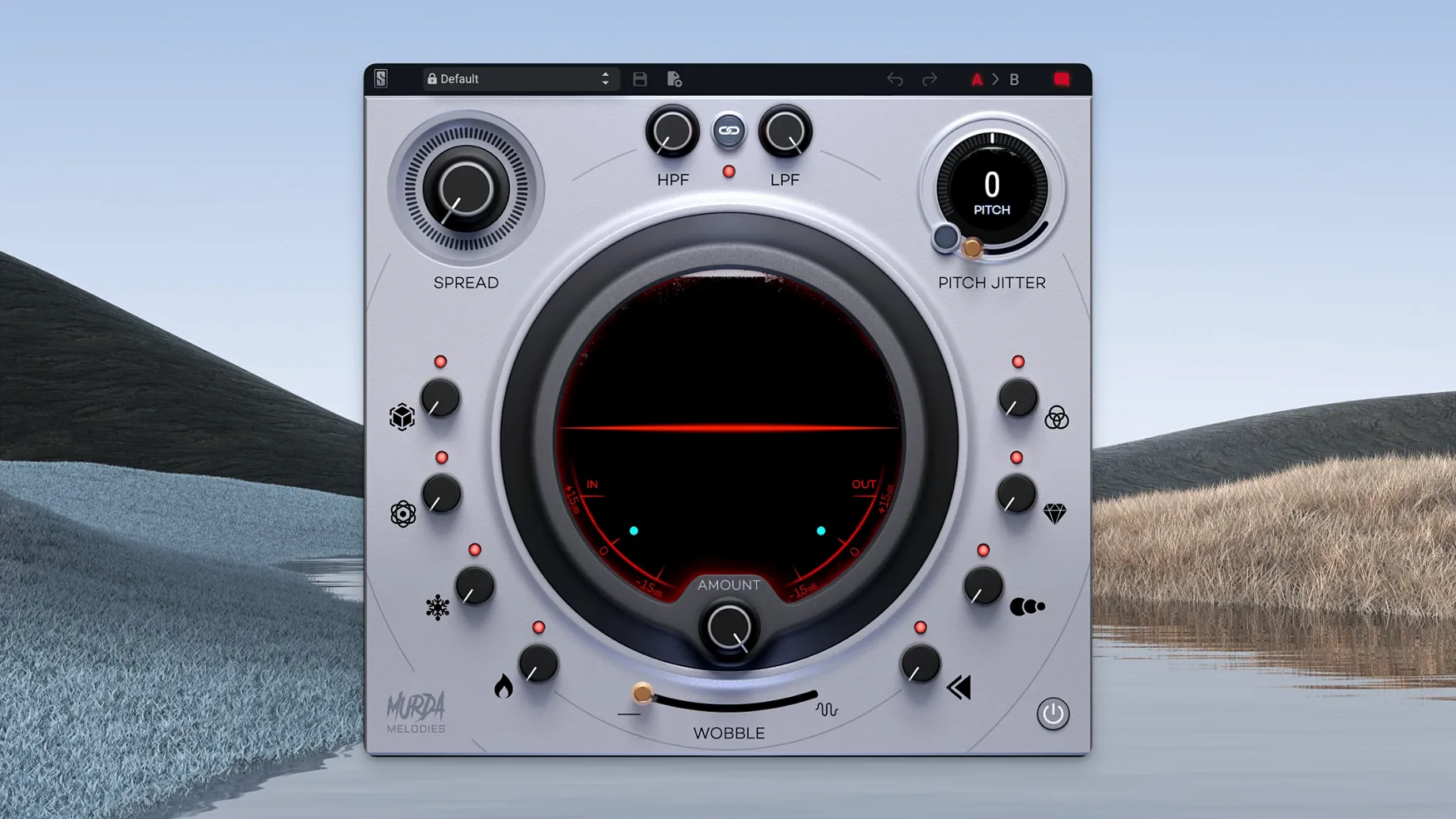
The pitch shifter spans four octaves, so a simple flute line can drop into a baritone growl or climb into chipmunk territory without wrecking the timing. Flip the key, then slap on the Pitch Jitter control to introduce the kind of wobbly artifacts that make a loop feel sampled from a dusty cassette.
Smear It Across the Stereo Field
The stereo widener stays mono-compatible, which matters when the beat has to knock on a phone speaker. Push a lead wide, and the low end doesn’t collapse into phase mush. The vinyl wobble effect does exactly what it says — warble and drift that sound like a turntable with a bad belt, tuned to musical chaos.
Start From a Preset, Not a Blank Page
Over 50 presets co-built by Murda Beatz and Slate Digital cover trap hi-hats, haunted keys, and washed-out pads. Pick one, tweak the macro controls, and keep the render bar moving.
A Session With Murda Melodies
I drop it on a synth pluck track that's been sitting naked in the arrangement. First move: open the preset browser. Murda Beatz's "Broken Music Box" patch catches my ear. The pitch shifter is already set to -7 semitones, and the delay is synced to dotted eighths. I bypass the reverb — it's washing out the transient — and crank the analog-modeled high-pass filter until the pluck bites through the low end of the 808. Thirty seconds in, and the track already sounds like it belongs on a different record.
Next, I route a vocal chop through the reverse processor. The buffer size defaults to a quarter note, so I switch it to an eighth and ride the wet/dry mix until the backwards swell peeks through only on the downbeat gaps. The Pitch Jitter sits at 11 o'clock, just enough to make the reverse tail warble without sounding like a corrupted MP3. I lock in the setting, duplicate the track, and pan the original dry vocal left while the processed signal pushes right — the mono-compatible widener keeps the phase meter happy when I check it in mono on the Avantone.
From a Trap Producer's Desk
Imagine a beatmaker who just pulled a loop from a pack. The melody is solid, but it sounds like every other loop that shipped with the same library. They insert Murda Melodies, load the "Lo-Fi Dream" preset, and immediately knock the pitch shifter down a fifth. The vinyl wobble goes to about 30%, adding a slow drift that makes the loop feel sampled from a thrift-store record. They bypass the built-in delay and send the output to a separate aux with Valhalla Supermassive for a longer tail. What started as stock material now carries the texture of something pulled off a Nineties R&B DAT tape. The client texts back: "this is hard."
Where RC-20, Infiltrator, and Thermal Split Off from Murda Melodies
Three plugins come to mind when you look at what Murda Melodies does: RC-20 Retro Color, Devious Machines Infiltrator, and Output Thermal. They overlap in the "character multi-effect" lane, but the lanes diverge quickly.
RC-20 Retro Color lives and breathes lo-fi degradation — noise, warble, wobble, bit-crush. It's a texture machine, not a melodic reshaper. It won't pitch-shift a melody four octaves or reverse audio in tempo-synced chunks. RC-20 makes things sound old; Murda Melodies makes them sound different.
Devious Machines Infiltrator is an effect sequencer — draw curves, trigger envelopes, modulate everything against a grid. It's surgical and infinite, but the learning curve is real. Murda Melodies trades that depth for immediacy: one knob per effect, no modulation matrix, no manual required. You reach for Infiltrator when you want to design an effect from scratch; you reach for Murda Melodies when you want a vibe in ten seconds.
Output Thermal leans into distortion and saturation, with a multiband engine that Murda Melodies doesn't attempt. Thermal can shred a sound; Murda Melodies can pitch it down an octave, reverse it, and smear it across the stereo field. They sit on different sides of the effects rack.
Grabbing Three Contrasting Presets Before Touching a Single Knob
When you grab the murda melodies mac build and install it, start with the presets — all fifty-plus of them. Don't try to learn every knob at once. Pick three patches that hit different moods: one for melodic reshaping, one for texture degradation, and one for stereo movement. Study which effects stay active in each preset and where the knobs land. That's your cheat sheet for what Murda Beatz actually reaches for.
Next, map the pitch shifter to a MIDI controller knob if your DAW lets you. Riding the pitch in real time during a bounce creates the kind of organic pitch bends that manual automation curves never quite nail. If you're hunting for the murda melodies free download route, just know that the 1.1.1 build with native Apple Silicon support avoids the CPU spikes that older versions had on M-series machines — worth seeking out specifically.
For trap and hip-hop sessions, try this chain on hi-hats: engage the vinyl wobble at around 20% depth, set the delay to sixteenth-note ping-pong, and roll off the high end with the low-pass filter until the hats sit behind the vocal. It glues programmed hi-hat rolls into the mix without burying them. If you're after the slate digital mac torrent that includes the full All Access bundle, Murda Melodies alone justifies the download for melody work — the pitch jitter and reverse processor combo creates textures that stock DAW plugins can't touch.
Last tip: the mono-compatible stereo widener works as a tone shaper in its own right. Push a pad or key sound to full width, then automate the width knob to narrow during the verse and spread during the hook. Subtle movement that doesn't smear on a Bluetooth speaker. Try that on your next chorus and watch the waveform breathe.
- macOS 11 or later
- Apple Silicon Mac
- AU, VST, VST3, or AAX host
- English interface
Questions I actually get
Who is Murda Melodies made for?
It’s built for hip-hop, trap, and R&B producers who want to twist melodies with pitch tricks, stereo movement, and analog-style instability.
Notes from the edit bay · 0
Sign in or get an edit-bay pass to leave a note.
No notes from the edit bay yet. They go up after I read them.