You drag a synth onto a MIDI track, feed it through a compressor, a tape delay, and a reverb you love from a different format entirely. That’s four plugins in one insert slot, and the whole chain records its output as audio. That’s the kind of routing Blue Cat’s PatchWork handles without forcing you to build a bus maze.
A Single Window, a Whole Signal Path
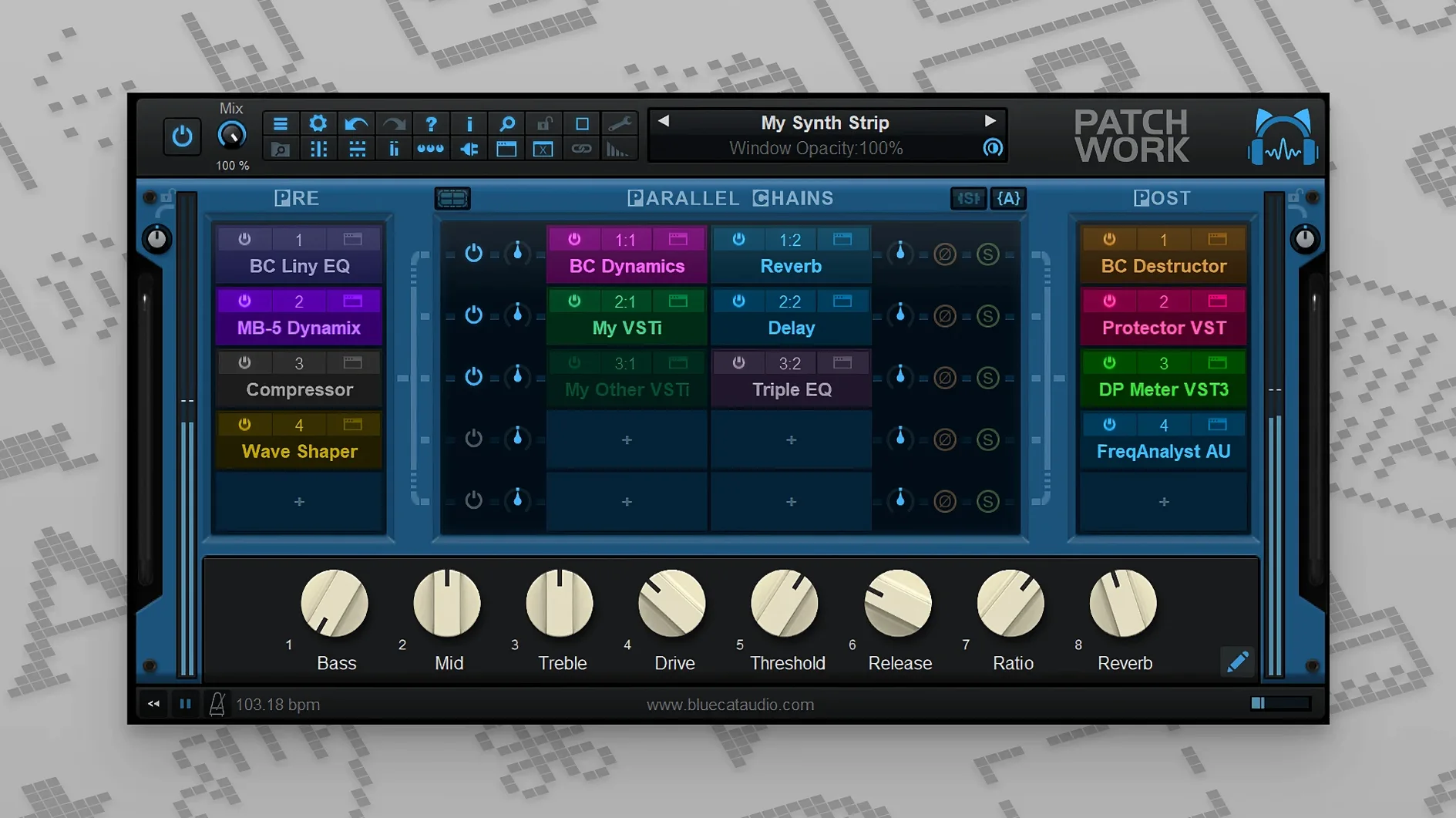
PatchWork sits inside your DAW as one instance. Open it and you get a blank rack where you can stack up to 64 plugins in series or parallel. The built-in browser lets you search across VST, VST3, AU, and AUv3 formats, scan new additions, and pull them in without restarting the session. I lean on the full-text search a lot when I need a specific compressor but can’t remember if I installed it as AU or VST3. Once a chain works, you copy it, save it, and drop it into another project. The 2.75 release made that quick, and the 16-channel audio recorder means I can capture a performance or a sound design pass right from the rack, no extra routing needed. Parameter control from MIDI got a bump too, with more event types making it easier to twist a filter cutoff from a controller while the rack runs.
Turning One DAW Slot into a Pedalboard
I use PatchWork when a DAW’s own routing feels slow or when a particular plugin format won’t load natively. It turns one slot into a pedalboard. Related Blue Cat tools like Axiom and Late Replies go deeper into amp modeling and multi-effects, but PatchWork is the utility player—the one you reach for to chain anything with anything and record the result.
Why You See an Empty VST3 Slot Until You Click
A few rough edges show up regularly enough to be worth knowing about. First, the VST3 editor quirk: on macOS, a VST3 plugin’s interface only loads when you click to open it. Until then you see an empty slot with a name. Not a bug, just a design choice, but it catches people off guard the first time they stack six VST3s and wonder why the rack looks half-blank. Click the slot, the GUI appears, and it stays cached until you close the project.
Another common one: dragging a plugin from the browser onto a slot that already holds something. PatchWork doesn’t swap the plugin, it stacks a second one after the first in series. If you want a replacement, clear the slot first with a right-click, or drop the new plugin onto the header bar of the old one. The manual mentions it, but nobody reads that until something sounds wrong.
Scan hiccups pop up too. A freshly installed plugin sometimes doesn’t show in the browser, especially if the developer used a non-standard component path. Open PatchWork’s preferences, hit the rescan button, and give it a minute. On Apple Silicon machines running plugins under Rosetta, a full AU rescan occasionally stalls. Quitting and relaunching the host app fixes it every time I’ve seen it.
Latency compensation across parallel chains is worth watching. PatchWork reports latency to the DAW for the whole rack, but if you split a signal into two parallel paths and one path has a lookahead limiter while the other is dry, the DAW can’t offset the difference inside the rack. The workaround is simple: drop a sample-delay or the built-in time-align plugin on the faster path and nudge it until the phase cancels out on a null test.
From Organic to Synthetic Mid-Phrase
Picture a sound designer working on creature vocals for an indie game. The brief asks for a call that shifts from organic to synthetic mid-phrase. She loads PatchWork on a track with the raw recording. Slot one gets an AU pitch shifter with a slow ramp mapped to a MIDI expression pedal. Slot two is a VST3 comb filter from a niche developer, its resonance tied to the same pedal. Slot three runs a built-in Blue Cat chorus for width. The parallel path underneath feeds a ring modulator followed by a convolution reverb loaded with a metallic impulse response. She hits the 16-channel recorder in PatchWork, performs the pedal sweep three times, and picks the best take. The whole chain saves as a single preset she drops onto the next creature’s vocal track without rebuilding a thing. That’s two hours of work in twenty minutes.
Playing Well with Others
PatchWork slides into a workflow alongside other Blue Cat tools without stepping on them. Someone using Axiom for amp and cabinet modeling might still load PatchWork inside Axiom’s post-FX section to chain four modulation pedals that Axiom’s own slots can’t accommodate in the same layout. The other direction works too: an instance of Late Replies loaded inside PatchWork to borrow its delay and reverb algorithms while PatchWork handles the broader signal split.
Outside the Blue Cat ecosystem, I frequently pair it with a DAW’s stock EQ and dynamics on separate insert slots while PatchWork handles the creative processing further down the chain. On a Mac, the standalone app talks to Core Audio directly, so I can feed a hardware synth into it, build a rack with AUv3 effects pulled from a Logic library, and route the output into a streaming app via BlackHole or Loopback. No DAW open, just PatchWork acting as a live effects rig. MIDI Learn picks up any knob twist from a connected controller and I map bypass toggles per plugin, something the 2.75 release finally added for individual slots.
When I need a search that spans every format I own, the built-in browser catches all of them—AU, VST, VST3, AUv3—in one keystroke. That alone changes how fast I audition alternatives during a mix. I hit Cmd+F, type a partial name, and results narrow as I type, which feels quicker than any DAW-native plugin menu I use.
- macOS 10.9 or newer
- Intel or Apple Silicon Mac
- 64-bit host application
Questions I actually get
Can Blue Cat's PatchWork host AUv3 plugins on a Mac?
Yes, the macOS version supports AUv3 instruments and effects alongside VST, VST3, and AU formats.
Notes from the edit bay · 0
Sign in or get an edit-bay pass to leave a note.
No notes from the edit bay yet. They go up after I read them.