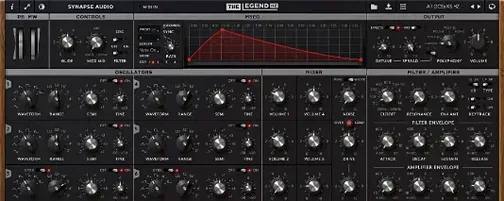
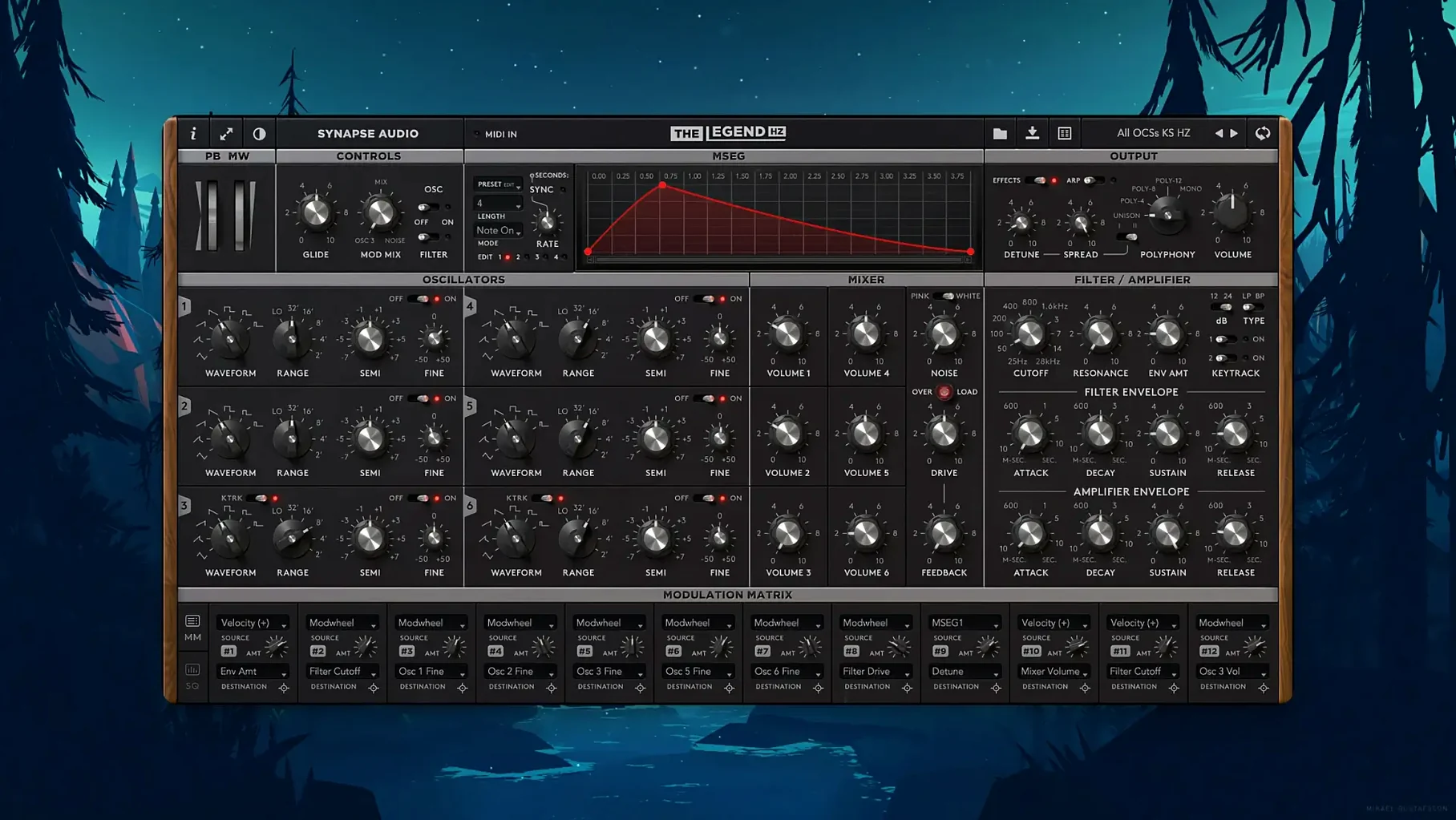
If you've spent time with a straight Minimoog emulation, you know the drill: three oscillators, that ladder filter, and a sound that sits in a dense mix without eating up the headroom. The Legend HZ takes that familiar template and blows it out to six VA oscillators, built from the ground up with Hans Zimmer's input. It's less of a direct clone and more of a scoring-stage reimagining of the original signal path.
Cinematic bass and drones that stay out of dialogue's way
- Cinematic bass and drones. The 914 Fixed Filter Bank lets you carve resonant, moving textures that lock into a cue without clouding dialogue.
- MPE controllers. With full MPE support and 12 voices of polyphony, this is a rare analog-modeled synth that responds to per-note pressure and slides like a hardware instrument.
- Loading legacy patches. Soundbanks made for the original The Legend load right in, so you keep your old go-to patches alongside the 200 new factory presets from Zimmer and Kevin Schroeder.
Mix-stage EQ and compression live outside the synthesis path
- The back-panel paragraphic EQ and compressor saturation, added in v2.1, live outside the main synthesis path. They're mix-stage tools, so expect to tweak them after you've locked in the patch itself.
- Six oscillators and the filter bank can eat CPU cycles fast. On complex sessions, you'll likely bounce to audio sooner than you would with a simpler subtractive synth.
The Legend HZ in a scoring session
Picture a composer on a Wednesday deadline, picture locked, orchestra printed, but the low-end tension cue still needs a pulse that breathes rather than loops. They pull up The Legend HZ, dial oscillator two down an octave, nudge oscillator six to a triangle wave a fifth up, and route three voices through the 914 Fixed Filter Bank with the 400 Hz frequency band pushed just past unity. Ten seconds later they're riding the mod wheel for filter cutoff while the arpeggiator runs a custom 16-step pattern in latch mode. The synth moves from a felt rumble to a glassy, metallic shimmer without a single automation lane drawn. That's the thing: you're not programming, you're performing. The 12-voice polyphony means chord stabs don't steal voices from the drone underneath, and MPE input from a Seaboard turns each note into its own expression lane. By the time the director walks in, the cue has a spine, and the editor hasn't touched a single sample pack.
Patch-stealing clicks and other fixable headaches
The Legend HZ sounds enormous, but it comes with a few recurring headaches that are easy to fix once you know where to look.
CPU spikes on long sustain patches
Six oscillators with the filter bank active and unison set to four voices can bring even an M-series Mac to its knees. The first thing to check is the voice count in the back panel—dropping from 12 to 8 voices rarely changes the sound but cuts processing almost in half. Also, the compressor saturation circuit added in v2.1 runs post-filter and stays active even when you're not hearing obvious gain reduction. If you're not using it for tone shaping, bypass it. Bouncing the drone to audio early saves grief during the final mix sprint.
Preset navigation feels slow at first
Two hundred factory patches isn't a huge library, but there's no tagging system, and the flat list means a lot of clicking. The quickest workflow is to save ten or fifteen "anchor" patches into a user folder named for the project. From there, you tweak and resave variants. People coming from Omnisphere or Pigments often expect a browser with star ratings—The Legend HZ isn't that synth, and fighting it wastes time. Treat the preset menu like a rack of labeled patch cables, not a database.
MPE setup confusion
MPE works beautifully, but your DAW has to route the per-note data correctly. In Logic Pro, you need to load the AU version and set the track's MIDI input to an MPE-capable port. If the mod wheel controls pitch instead of the filter, you've got the global and per-note channels swapped in your controller's settings. The Legend HZ listens on channels 2–13 for individual notes and reserves channel 1 for global messages—match that on the hardware side and it snaps into place.
Which analog-modeled synth fits your daily workflow
The Legend HZ doesn't live in a vacuum. A few other analog-modeled instruments occupy the same rough lane, and the differences come down to what you're actually doing day to day.
The Legend HZ vs. Diva
U-he Diva offers multiple oscillator and filter models in one package, so you can mix a Moog-style ladder filter with a Roland-inspired envelope. That flexibility is Diva's strength, but it also means you spend more time auditioning combinations. The Legend HZ commits to one signal path and pushes it further—six oscillators, the 914 filter bank, and the MPE implementation all feel like a single instrument rather than a toolkit. For a composer who needs one analog voice that covers basses, leads, and drones without module-swapping, The Legend HZ is faster. For a sound designer who wants to Frankenstein circuits together every session, Diva wins.
The Legend HZ vs. Softube Model 72
Softube's Model 72 is a component-modeled Minimoog that leans hard into authenticity, right down to the quirks of the original power supply. It sounds fantastic for classic lead lines and funk basses. What it doesn't do is polyphony, MPE, or the fixed filter bank. If you're after a purist recreation and nothing else, the Model 72 delivers. The Legend HZ is for people who love that tonality but need it to stretch across a modern scoring template—polyphonic pads, per-note expression, and the kind of spectral sculpting that a standard three-oscillator layout can't reach.
The Legend HZ vs. GForce impOSCar3
impOSCar3 models the OSCar synth, not a Moog, but it's often cross-shopped because both instruments sit in the "character analog with a twist" category. impOSCar3 has additive waveforms and a unique filter design that gets aggressive in a way The Legend HZ doesn't. The trade-off is that impOSCar3's polyphony implementation feels less immediate for MPE work, and its patch management is busier. The Legend HZ keeps the panel logical—every knob maps to something you'd find on a well-maintained vintage console. If you want snarling digital-edged textures, impOSCar3. If you want a Moog-derived engine that can still surprise you at 23 Hz with sub-bass weight that shakes a nearfield monitor, The Legend HZ.
What v2.1 changed in everyday use
The jump to version 2.1 brought four concrete additions that shift how you work with the plugin, not just what it says on the tin.
The paragraphic EQ on the back panel is the kind of tool you'd normally reach for a separate channel strip to handle. Having it built in means you can carve out a 400 Hz frequency buildup from a bass patch right at the source, before it hits your DAW's mixer. In practice, that saves a slot and keeps your channel count cleaner when you're stacking four or five instances in a cue.
Compressor saturation is subtle until you push it, and then it glues the oscillator output in a way that mimics the final gain stage of a hardware desk. It's not a full dynamics processor—think of it as a tone control with attitude. Dial it in gently on a unison lead and the highs smooth out without losing bite.
MTS-ESP microtuning support is the sleeper feature. If you work with orchestral libraries that use non-equal-tempered scales, or if you collaborate with musicians who play in just intonation, The Legend HZ now follows the session-wide tuning table automatically. No more retuning every patch by hand.
The 50 new presets from Kevin Schroeder lean into the filter bank and MPE capabilities more than the original factory set. A handful of them are built specifically for the 99 r1 resonance behavior of the 914 bank, producing almost vocal formant sweeps. Loading one of those and riding the mod wheel feels less like a preset demo and more like playing an instrument
The back panel now packs a paragraphic equalizer — handy for surgical tone shaping without leaving the plug-in window. Compressor saturation has been added to the output stage, which thickens plucks and basses before they hit your DAW's channel strip.
Also fixed: MTS-ESP microtuning support is now baked in, and Kevin Schroeder contributed 50 new factory presets that show off the six-oscillator architecture and fixed filter bank.
- macOS 10.14 or later
- Apple Silicon and Intel Macs supported
- VST, Audio Unit, or AAX host
Questions I actually get
What formats does The Legend HZ run in?
It ships as a VST, Audio Unit, and AAX plug-in, so it fits into Logic Pro, Cubase, Pro Tools, and most other DAWs on macOS.
Can I use patches from the original The Legend synth?
Yes. The Legend HZ can load patches and soundbanks created for The Legend, so your existing library carries over.
Who created the factory presets?
The 200 included presets were designed by Hans Zimmer and Kevin Schroeder, with an extra 50 added by Schroeder in version 2.1.
Notes from the edit bay · 0
Sign in or get an edit-bay pass to leave a note.
No notes from the edit bay yet. They go up after I read them.