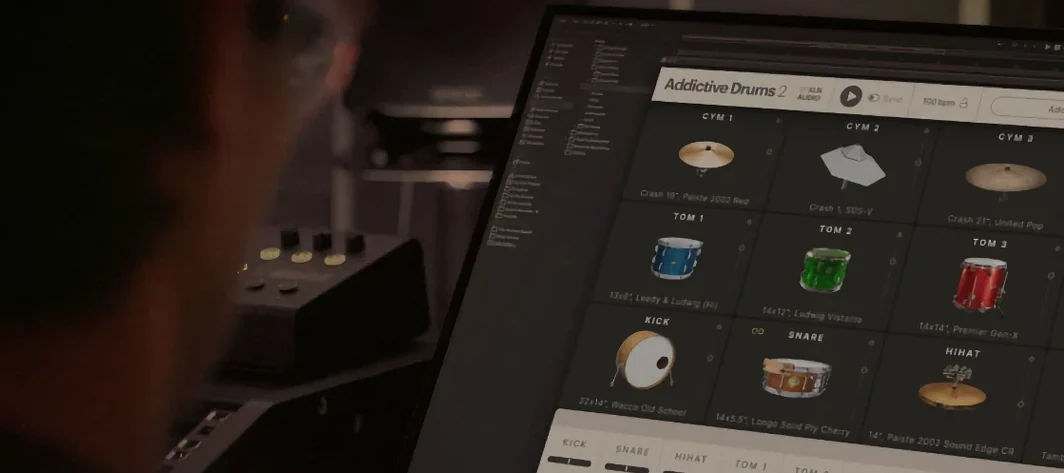
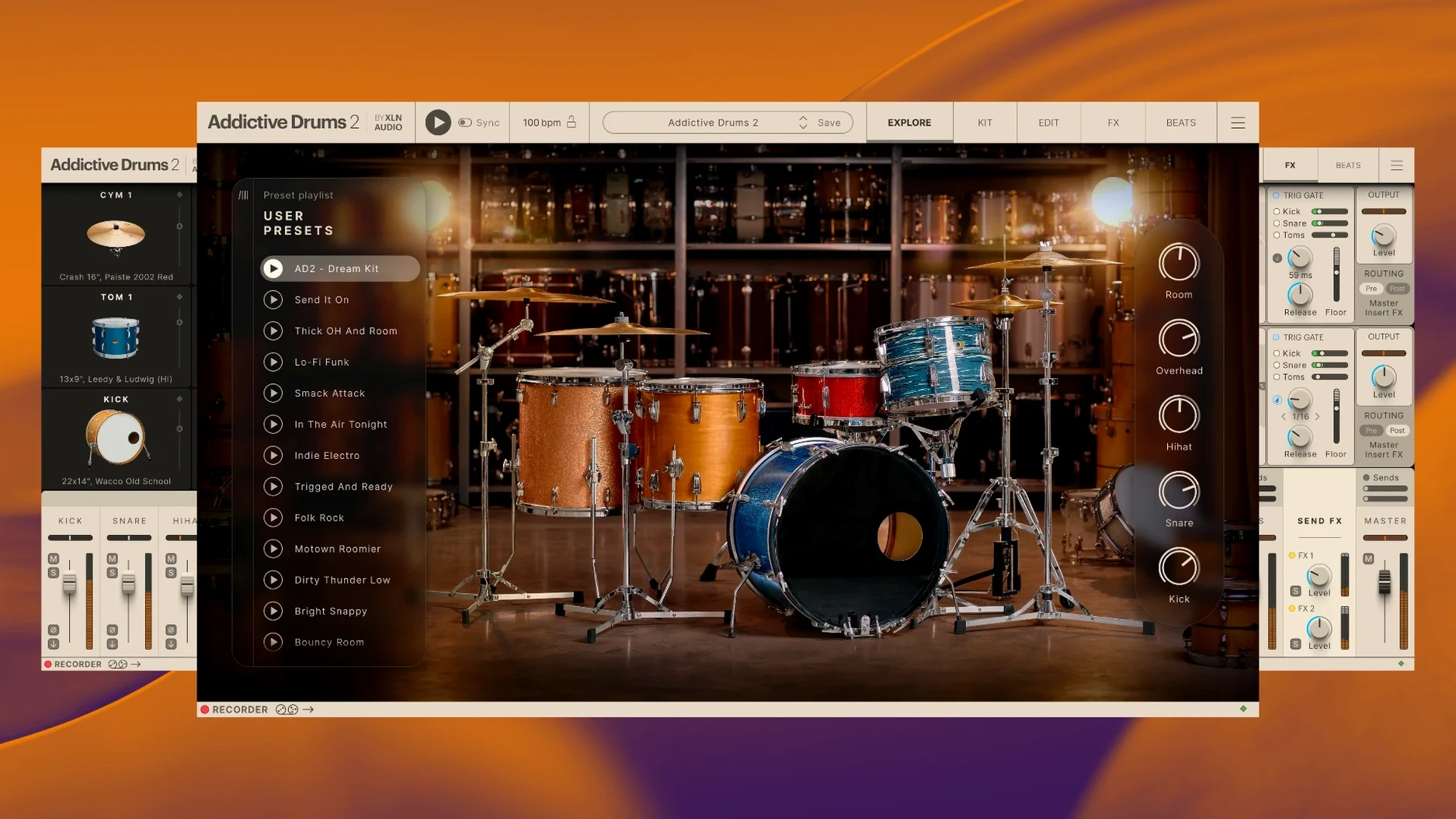
The current 2.9.1 build keeps the engine focused on one thing: getting a convincing kit playing inside your session without a pile of routing gymnastics. That matters when a cut is waiting on a render bar.
Why This Instrument Track Beats a Sample Browser
This is not a sample browser you audition for an hour. Addictive Drums 2 sits on an instrument track, fed by MIDI you either pull from a MIDIpak or play in yourself. The Complete Collection bundles every ADpak, MIDIpak, and Kitpiece Pak, so the kit choices are already there — no hunting for expansions mid-project.
For mixing, the plugin gives you individual channels for kick, snare, toms, overheads, and room. I usually route those to separate buses in my DAW for parallel compression or reverb sends. It keeps the drum balance moving without touching the other stems.
When Your Drum Part Needs a Drummer, Not a Grid
- Session work where a drum part needs to sound like a drummer, not a grid
- Corporate and music videos that need a believable kit in the mix quickly
- Editors who want to tweak a beat from a groove without re-tracking MIDI
- Projects that benefit from having all ADpaks and MIDIpaks in one install
English-Only Interface and Mac Compatibility Limits
- The interface is English only.
- It supports macOS 10.13 and later, both Intel and Apple Silicon, as a 64-bit instrument.
Can You Play Kits Without Opening a DAW?
Does this thing work standalone, or do I need a DAW? Both. There is a standalone application for macOS, so you can fire it up, load a kit, and play without touching Logic or Live. I use the standalone when I just want to audition a beat idea. The plugin version loads in any AU, VST, or AAX host. Same engine, same kits.
What does the Complete Collection actually include? Every ADpak — that is the Fairfax, Black Velvet, United Heavy, Funk, Reel Machines, Boutique Mallets, and all the rest. Every MIDIpak from every style pack. Every Kitpiece Pak. You are not buying a base engine and then chasing down the rock kit you actually need. One install, everything present.
How big is the download? Large. This is a collection of deeply sampled kits with multiple velocity layers and round robins, plus thousands of MIDI grooves. Expect to clear some space. The split archive approach helps if your connection is patchy — you grab the parts, put them in one folder, and extract the first .zip.001 with Keka.
Does it hit the CPU hard? Not in a way that derails a session. I run it on a mix of Intel and Apple Silicon machines and the 64-bit engine stays efficient. More on that below.
Will the MIDI grooves sound mechanical? They do not. The beats were performed by actual drummers and captured with the dynamics intact. Drag one into your DAW and the velocity data is already there — ghost notes, flams, the slight push on a hi-hat. It feels less like programming and more like editing a performance.
A Scenario: Music Video Editor Lands a Last-Minute Revision
Tuesday, 4 p.m. The director sends a note: the bridge needs more energy, and the temp drums sound like a typewriter. The cut locks in three hours.
I open the session, load Addictive Drums 2 on an instrument track, and pull up the Black Velvet kit — deep kick, crack from the snare, nothing polite. I browse MIDIpaks tagged "rock" and find a groove that moves in the right pattern. Drag it to the track. The overheads and room mics are already balanced in the plugin mixer, so I solo the kick and snare channels, route them to separate buses, and add a touch of parallel compression to the room. The drums sit under the sync footage without fighting the guitars.
Twenty minutes in, I swap the ride for a darker cymbal from the kit piece browser. Another ten minutes nudging fills to hit the cut points. Render. The director asks if I hired a session drummer. I did not correct him.
That is the value here: a believable kit performance, shaped fast, without opening three other plugins just to make the toms audible.
Fairfax Kit Loads Before You Adjust Your Chair
Loading a full ADpak takes a few seconds on an Apple Silicon Mac — the Fairfax kit with all articulations and mics is ready before I finish adjusting my chair. On an older Intel machine, the same kit might take eight or ten seconds, still reasonable. Once loaded, patch switching between kits is near-instant.
Memory use varies by kit complexity. A standard rock kit with overheads, room, and close mics sits around 300 to 500 MB of RAM. Bigger setups — Boutique Mallets or the orchestral percussion Adpak — push closer to a gigabyte. The engine streams samples from disk intelligently; I have never seen it spike the memory pressure into the red on a 16 GB machine, even with other virtual instruments running.
CPU hit is modest. Playing back a dense MIDI groove with all mic channels active and some onboard effects — compression on the kick, a touch of tape saturation on the room — hovers around 10 to 15 percent on a single core. The plugin multithreads well enough that it does not choke when the DAW is under load. Stability is solid; I have not had a crash trace back to Addictive Drums 2 in months of sessions, and the current 2.9.1 build has been predictable across different hosts.
One thing that helps: the internal effects — EQ, compression, transient shaping, tape saturation, reverb — are baked into the kit presets and do not require external plugins. You can shape the sound entirely inside the instrument and print or route the processed channels. That saves insert slots and keeps the session moving when plugin counts climb.
Video Editors Mixing Their Own Corporate Spots
Video editors who mix their own audio. If you cut corporate spots, event recaps, or music videos and need a kit that sounds like a kit, not a machine, the groove library and mix-ready presets cut hours from the process. Drag a MIDI groove, tweak the pattern, route the kick to a bus, done.
Songwriters and producers who do not play drums. The MIDIpaks cover a range of genres — rock, pop, funk, metal, indie, jazz, soul — and the patterns are structured in song sections. Verse, chorus, bridge, fill. You assemble a drum arrangement by dragging sections, not by clicking notes into a piano roll. If you do play, a MIDI kit or electronic pad triggers the kits with realistic velocity response.
Engineers who mix multitrack drums. The plugin gives you discrete outputs for every microphone. You get kick in, kick out, snare top, snare bottom, hi-hat, tom close mics, overheads, room, and sometimes extra ambient channels depending on the ADpak. Treat them like recorded tracks. Process them on your console or in your DAW with your own chain. The raw samples hold up to heavy processing.
Anyone who wants all the kits without piecemeal downloads. The Complete Collection is the draw here — every ADpak, every MIDIpak, every Kitpiece Pak in one installer. If you have ever tried to assemble a drum library across a dozen separate purchases, you know how tedious that gets. This is one archive, one extraction, one authorization.
Flip the Master Out to a Multi-Out Setup
Out of the box, the plugin works. A few tweaks make it work the way you do.
Set the default output routing. The mixer defaults to a stereo master out. Go to the Setup tab, enable multi-out, and assign kick, snare, toms, hi-hat, overheads, and room to individual channels. Save that as your default user preset. Every new instance will open with discrete outputs ready for your DAW routing.
Dial back the room on presets. Many kit presets arrive with the room mic fairly loud — great for inspiration, often too washy in a dense mix. I pull the room fader down 3 to 6 dB as a starting habit and bring it up only if the track needs the space.
Switch the MIDI mapping early. The default mapping follows the General MIDI standard. If you use an electronic kit or a pad controller that sends different notes, open the Map Window and choose the preset for your device — Roland, Yamaha, Alesis, whatever. Doing this before you start tracking saves the headache of reassigning articulations later.
Turn off effects you do not need. Each channel can load compression, EQ, distortion, and tape saturation. On a busy session, disable unused insert slots. The CPU savings add up when multiple instances run, and you can always re-enable a compressor when you are actually dialing in the kick sound.
Adjust the velocity curve. In the Settings menu, the velocity response curve defaults to linear. If your MIDI controller runs hot — every hit registers near 127 — bend the curve downward. If you play lightly and want more presence, push it upward. A few minutes here makes the difference between drums that breathe and drums that shout.
Build a shortlist of go-to kit pieces. The Complete Collection means hundreds of snares, kicks, cymbals, and toms. Mark your favorites as you find them. I keep a tight set: the Black Velvet kick, the Fairfax snare, the darker hi-hat from United Heavy, a splash from the Funk ADpak. Swapping pieces on the fly is fast when you are not scrolling through every option.
- macOS 10.13 or later
- Intel or Apple Silicon (ARM and x86 64-bit)
- 64-bit host
Questions I actually get
Does Addictive Drums 2 run on Apple Silicon Macs?
Yes. The current version supports both ARM and x86 64-bit architectures on macOS 10.13 or newer.
Notes from the edit bay · 0
Sign in or get an edit-bay pass to leave a note.
No notes from the edit bay yet. They go up after I read them.