Your spymaster just uncovered a plot against your son. Meanwhile, your cousin in Burgundy is eyeing your title, and the Holy Roman Emperor keeps demanding you join his pointless wars. Welcome to a quiet Tuesday in Crusader Kings III.
Game — a medieval grand strategy and role-playing hybrid about dynastiesDeveloper — Paradox Development Studio
Your job — keep your bloodline on the map, by any means necessary
Works through — war, diplomacy, domain management, and personal schemes
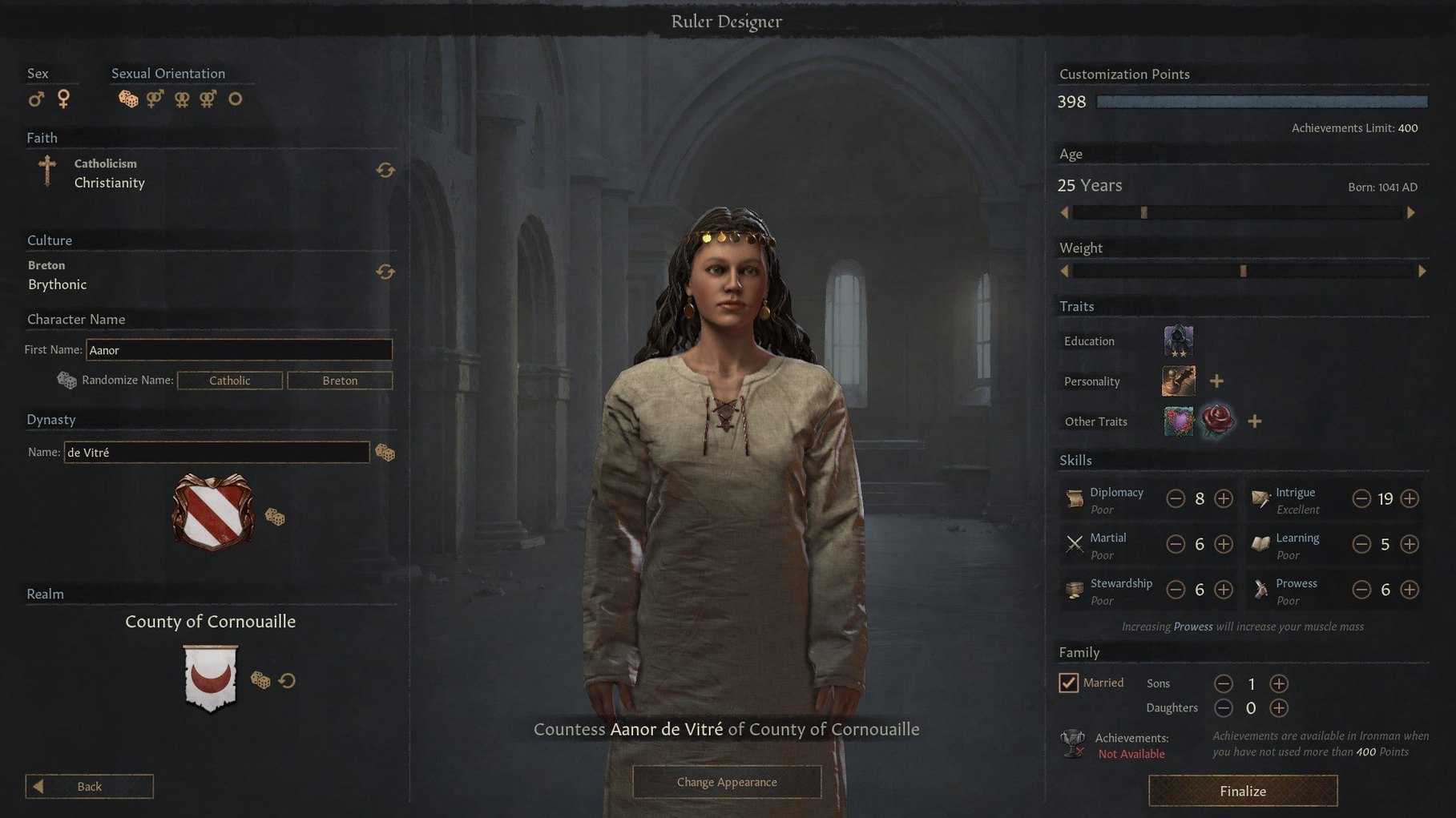
CK3 hands you a character — a count, a duke, a king — and dares you to outlive your rivals. War is one way to grab power, but it is rarely the smartest. Diplomacy smooths over succession crises. Managing your personal domain funds the army. And the role-playing layer turns every vassal into a personality you have to read, appease, or assassinate.
This is the player it suits: someone who loves seeing a story unfold from their decisions. If you get attached to characters, hold grudges against fictional nobles, and enjoy spending an hour in a menu deciding who your heir marries, CK3 fits. It rewards patience and a tolerance for chaos.
It is not for players who want a tight, win-condition strategy game. There is no pop-up declaring victory. You set your own goals. If you need the game to tell you you have won, CK3 will feel aimless. If you treat a single inheritance gone wrong as a plot twist rather than a fail state, you are home.
Questions People Actually Ask
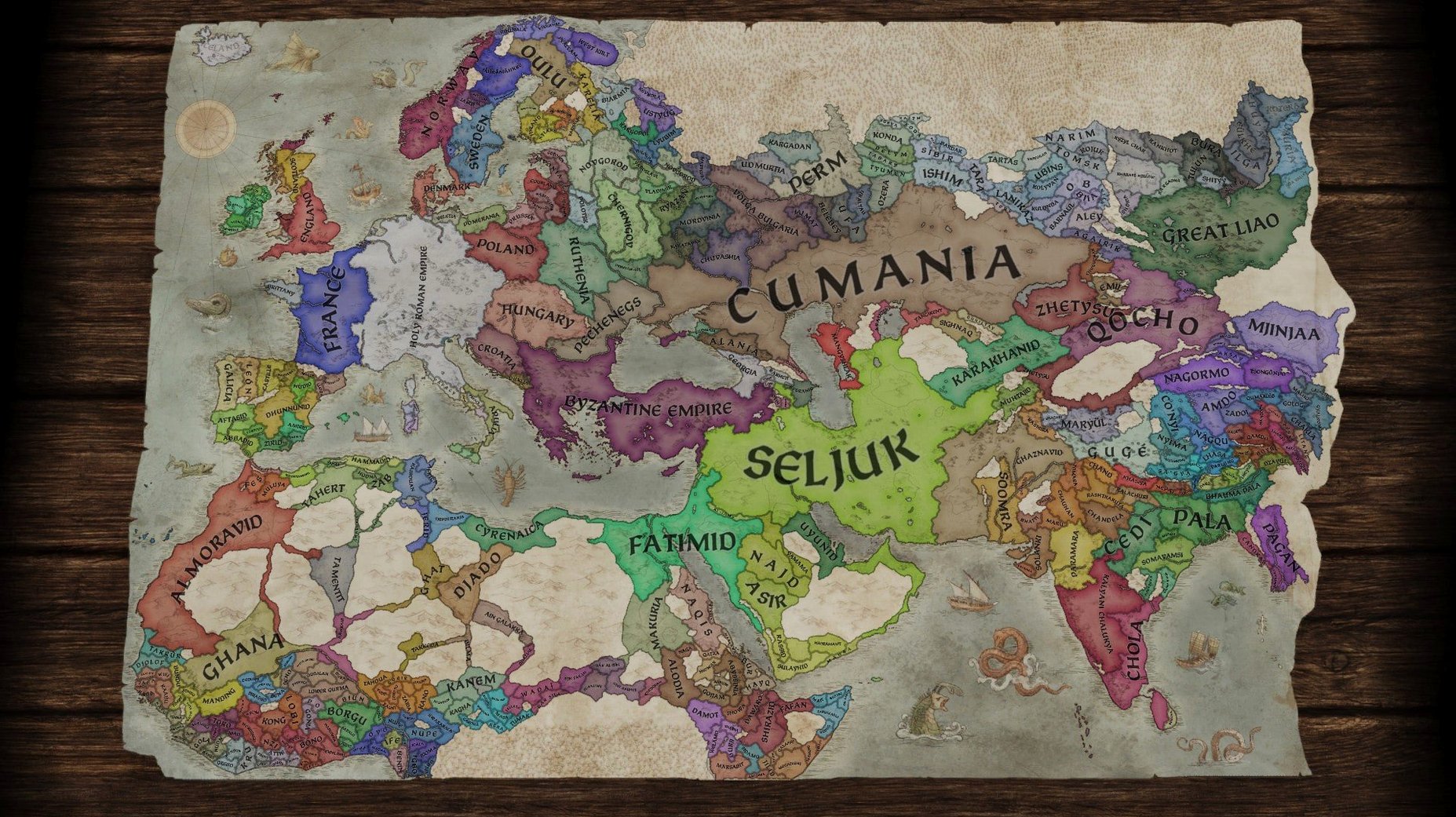
"Do I need to know medieval history?" Not at all. The map, cultures and religions are rooted in 867 and 1066, but the game treats them as starting conditions, not a pop quiz. You learn the difference between a duke and a count by playing one. If you do know the period, you will catch small historical nods, but CK3 never punishes ignorance.
"How bad is the learning curve?" The tutorial does a solid job. It drops you in Ireland — nicknamed "Tutorial Island" for a reason — and walks you through the council, marriages and your first petty war. After 90 minutes, you understand the loop. After five hours, you start seeing the second- and third-order consequences. Paradox grand strategy has a reputation for spreadsheet density, but CK3 moved a lot of the math behind tooltips and character portraits.
"Is it playable without a gaming mouse?" Yes. The interface is built around pausing, reading and clicking portraits. A trackpad works fine. You will right-click a lot, so enable two-finger secondary click if you haven't already. The game runs on the Intel Mac build tested here, and pausing means even late-game slowdowns don't kill you — you're not twitch-reacting to anything.
"Do I have to play for 10 hours straight?" You can, and you might, but CK3 respects short sessions. A single lifetime — say, 40 in-game years — can play out in under an hour. You can stop after a character dies, or after a war concludes, and the game still feels complete. There is no cliffhanger mechanic forcing another turn.
The First Ruler: A Workflow from Start to Death
Here is a concrete path for your first serious attempt. Pick the 1066 start, choose Duke Vratislav of Bohemia. He has a strong economy, a liege who mostly leaves him alone, and a clear short-term goal: form the Kingdom of Bohemia.
1. Pause and read your council. Open the council screen. Look at your chancellor's diplomacy, your marshal's martial skill. Assign the chancellor to improve relations with the Holy Roman Emperor — you need him indifferent, not hostile. Send the marshal to train commanders. Boring, but it compounds.
2. Marry for stats, not claims. Open the character finder, filter for unmarried women, sort by stewardship or learning. Vratislav needs a wife who boosts domain income. Claims are a trap this early — you are not invading anyone yet. Marry, then set your spouse to "Manage Domain" in the council tab.
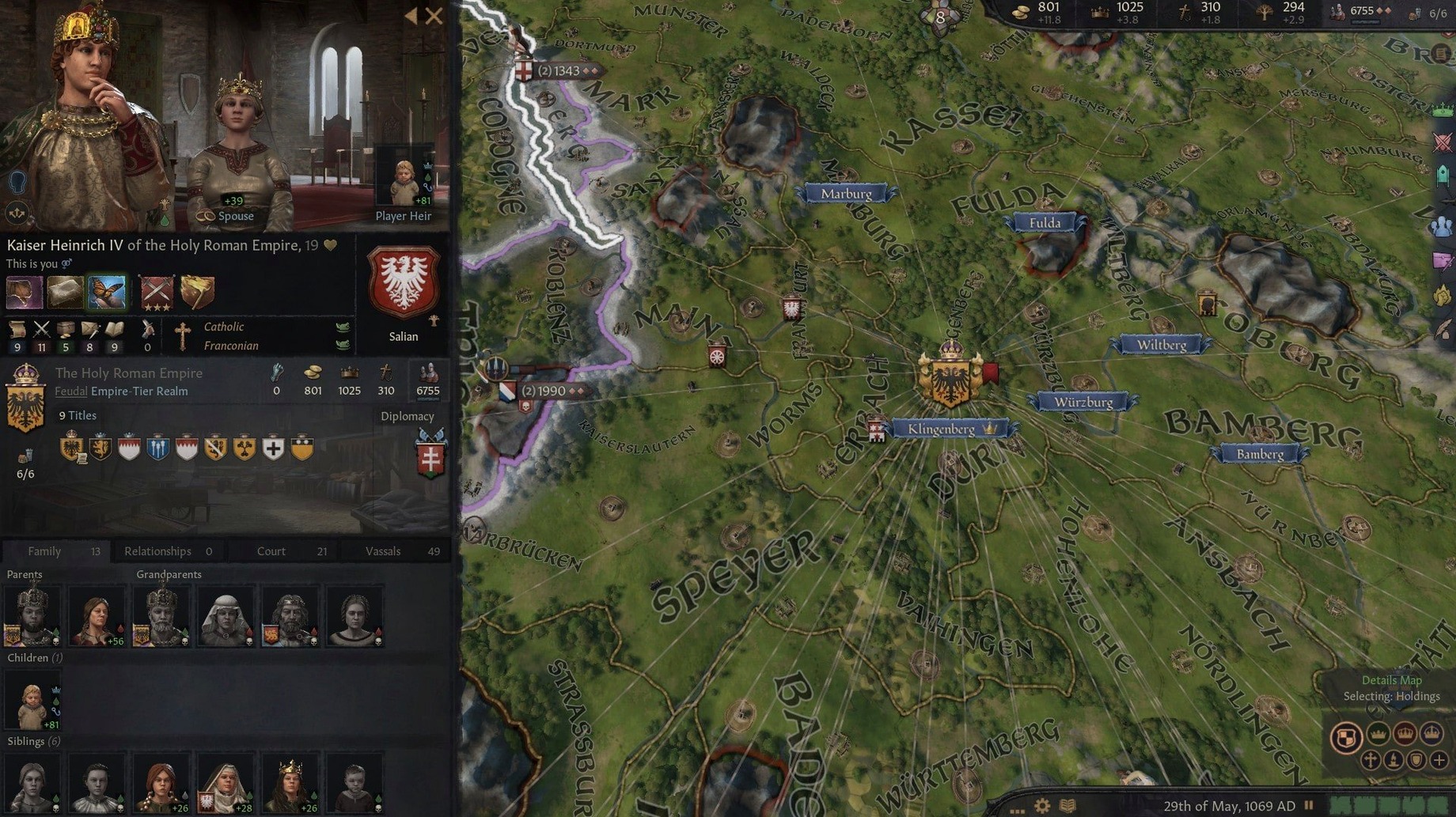
3. Check the succession screen. Under the realm tab, see what happens when Vratislav dies. Partition inheritance is the default; your land splits among sons. That is a problem for later, but you need to know it's coming. Make a mental note: you want a single top-tier title before you die.
4. Fabricate a claim. Your chancellor can fabricate a claim on a neighboring county. Send him to a county in the de jure Kingdom of Bohemia. It takes years. While he works, build a gold reserve and keep your vassals out of factions by swaying the strongest one.
5. Press the claim, win the war, repeat. Raise your levies, siege the county, win the single battle that decides it. Do this twice and you have the land to create the kingdom title. By the time Vratislav is 60, you sit on a stable realm with one heir inheriting everything. That is a clean run.
Slow to Speed 3 So Sudden Deaths Don’t Blindside You
Slow the speed to 3. Speed 4 and 5 are for when nothing is happening. At speed 3, you can react to a sudden death, a faction ultimatum or a child being betrothed to a rival family. You will miss fewer messages.
Stress is not a suggestion. Characters have traits — shy, ambitious, compassionate — and acting against them piles on stress. A shy character who has to sway five vassals will crack. At stress level 2, you start seeing real penalties. Let your character's personality guide decisions. It is not min-maxing; it is survival.
Knights matter more than levies. Early on, your knight roster decides battles. Use the "Invite Knights" decision if you have gold to spare. Sort your knights by prowess and kick out anyone with under 10. A knight with 20 prowess can rout a flank alone.
Watch your court physician. Appoint someone with high learning. When disease hits — and version 1.19.0.6 ensures epidemics are lethal again — you want the "Risky Treatment" option to actually work. A bad physician kills you faster than the plague.
Heirs are not spare characters. Your primary heir needs a guardian with high stewardship or diplomacy, not your marshal. Your second son can be a knight. Your daughter can be married matrilineally to a claimant. Treat each child as a tool with a 30-year training arc.
- Apple Silicon or Intel 64-bit Mac
Questions I actually get
Is Crusader Kings III only about war?
No. While war is one way to gain power, diplomacy, intrigue, and managing your personal domain are equally important for a successful rule.
Does the game have a fixed end goal?
There is no single victory screen. The goal is to build and rule a dynasty through the medieval setting, and you decide what success looks like for your bloodline.
Notes from the edit bay · 0
Sign in or get an edit-bay pass to leave a note.
No notes from the edit bay yet. They go up after I read them.